Hope isn’t the opposite of uncertainty…..It’s one of the things that helps us move through it.
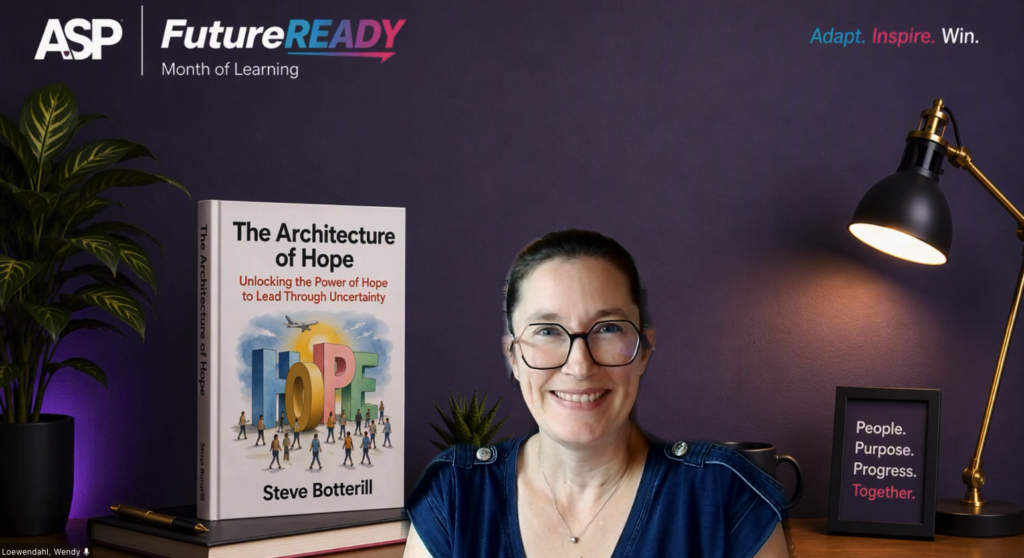
30 September 2026I recently had the pleasure of being invited by an old colleague, and now client Wendy Loewendahl (Weber), to contribute to ASP’s Month of Learning, which is part of Advanced Sterilization Products fabulous ‘Future Ready’ initiative.
Wendy kindly asked me to record a short session exploring something I’ve become increasingly passionate about: how hope can act as an accelerant to enable & facilitate change.
For clarity, this is not hope as wishful thinking or simply crossing our fingers and hoping everything will somehow work out. It is hope as something far more practical, something that helps people to see possibility, identify a way forward and, importantly, take action. That’s why in the AQai ACE model the sub dimension of HOPE is so important and hence why we can actually measure it through the AQai – Adaptability Assessments & Coaching tool.
That distinction is really important when organisations are navigating change. Because people rarely resist change simply because they dislike change. Often there is uncertainty, loss of control, fear of what comes next, or simply an inability to see a credible path forward. That’s where hope can become incredibly powerful. It can help us move from “What is happening to me?” towards “What can I do next?”
It was lovely to share some of the thinking and learning behind the five themes and three distinct phases of hope that I explain in my book, The Architecture of Hope, and I have to say, Wendy rather surpassed herself with the backdrop! 😊
For me, it reinforced something increasingly central to our work at Resourceful People Group Ltd: that if we want people to be Change Ready, we have to give them reasons to believe that they can influence what happens next. Hope may not be a strategy in itself but it is definitely an infrastructure that can make all the difference between success and failure.
People First. Change Ready.